
until our next session.
Estimated reading time: 8 minutes
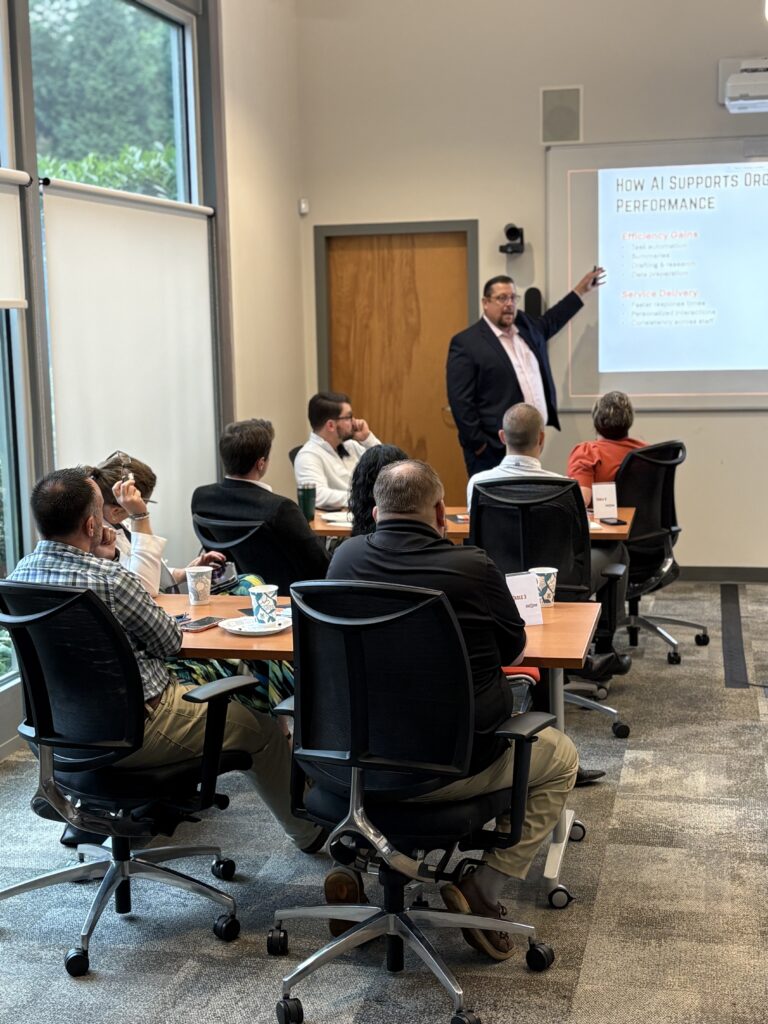
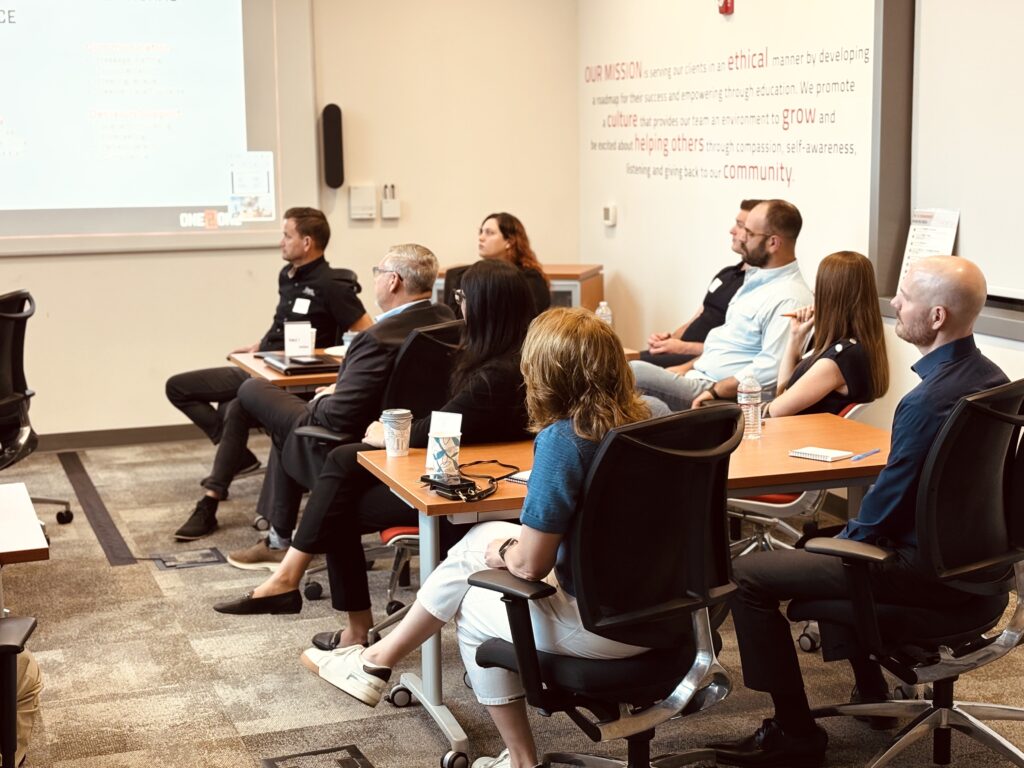
We hosted a mix of leaders from various industries including construction, finance, consulting, marketing, and small businesses were able to share their pain points and experiences, and questions centered around tech’s biggest buzzword. AI.
This session was built around one simple question: How can we help?
What we found was clear: people were not just asking, how do we use AI?
They’re asking, how do we keep our work human?
How do we save time without creating risk?
How do we use AI for real business problems, not just as a trendy experiment?
The conversation moved beyond “What is AI?” and into “How can AI actually support the work we are already doing?”
Rather than focusing on AI as a general concept, leaders began identifying where it could actually reduce friction, save time, and support better decision-making in their day-to-day work.
Attendees were intentionally grouped by business function to create a more focused and strategic exchange among leaders navigating similar challenges.
By bringing peers with overlapping responsibilities to the same table, the conversation quickly moved beyond surface-level interest in AI and into practical, business-specific discussions around efficiency, risk, decision-making, and competitive advantage.
Industry-specific AI opportunities discussed
The construction group, attendees discussed how AI can assist with contract review and time-consuming document work by summarizing contracts, identifying key terms, flagging potential risks, and reducing review time.
In the finance group, discussion of how AI can support the review of prospectuses, market data, and other complex financial documents by pulling out key insights and making information easier to digest.
For consulting and marketing, Questions like how AI can refine ideal client profiles, strengthen messaging, generate new ideas, plan campaigns, and support content creation.
For small business leaders, the conversation centered around using AI safely and responsibly through clear policies, approved tools, employee training, and practical implementation steps.
Industry-Specific Pain Points Captured
| Industry / Function | Pain or Interest Shared | AI Opportunity |
| Construction | Contract review and time-consuming document work | Use AI to summarize contracts, identify key terms, flag risks, and reduce review time. |
| Finance | Reading prospectuses and market data | Use AI to summarize complex financial documents and highlight key insights. |
| Consulting | ICP clarity, marketing strategy, and generating new ideas | Use AI to refine positioning, identify target audiences, and support strategic planning. |
| Marketing | Content creation, campaign timing, and product promotion | Use AI to support content planning, campaign calendars, audience targeting, and messaging. |
| Small Business Leadership | AI best practices, safety, ethics, and practical implementation | Use AI with policies, approved tools, employee training, and clear internal expectations. |
What the Data Shows
A major theme was efficiency. Attendees wanted to know where repetitive work could be reduced, how to improve workflows, and how their team can focus more on the things they enjoy doing and higher return rate activities, rather than redundant tasks such as overlooking data.
Some attendees wanted help with ICP clarity, marketing, and content.
Others were thinking about contracts, prospect addresses, market data, process automation, and business efficiency.
Multiple attendees asked about using AI ethically, securely, and in a way that still keeps people involved.
There were especially clear questions about automating processes such as reviewing contracts, reading financial documents, and improving overall business operations.
Marketing stuck out as a clear overlapping area of interest.
Attendees asked about AI implementations for campaign timing, ICP clarity, and more targeted messaging.
Overall, this data shows that Leaders want to utilize Ai for better strategy, better timing, and fine-tuning customer journey and communication.
Key Themes We Heard
| Theme | What Attendees Asked About | What This Tells Us |
| Safe and Responsible AI Use | AI safety, overuse, ethics, keeping business secure and human | Leaders want to use AI, but they are concerned about risk, privacy, and losing the human element. |
| Better Prompting and AI Literacy | How to get better results from prompts, which AI tools are most powerful | Attendees want clearer guidance on how to use AI effectively, not just access to the tools. |
| Marketing and Content Support | Marketing, content, timing for campaigns, ICP clarity | Marketing teams want AI to help with strategy, content creation, targeting, and timing. |
| Process Automation and Efficiency | Automating processes, reducing repetitive work, improving business efficiency | Businesses are looking for ways AI can save time and reduce manual work. |
| Industry-Specific Use Cases | Contracts in construction, prospectuses and market data in finance | Attendees want AI examples that apply directly to their industries and daily responsibilities. |
| Human-Centered Creativity | Caricatures, creative uses, networking, new ideas | AI is also being viewed as a tool for creativity, connection, and fresh thinking. |
AI Still Needs Human Review
Throughout the conversation, one thing became clear: leaders are interested in using AI to improve efficiency, but they do not want to remove the human judgment that makes their work valuable.
That distinction matters.
AI may be able to summarize a contract, highlight key points in a prospectus, draft a campaign outline, or suggest new messaging.
But those outputs still need to be reviewed by someone who understands the context, the client, the industry, and the business decision being made.
AI can support the work, but it should not be treated as the final authority.
This is especially important in areas like construction, finance, consulting, and marketing, where accuracy, trust, and context matter.
A summary may be helpful, but it should not replace legal review.
A market insight may be useful, but it should not replace financial expertise.
A marketing draft may save time, but it still needs brand voice, audience awareness, and human creativity.
The businesses that use AI well will not be the ones that remove people from the process.
They will be the ones that use AI to give their people more time, better information, and stronger support.
Why This Matters Now
AI is moving quickly, and many businesses are feeling pressure to keep up.
But moving quickly without a plan can create confusion. Teams may start using different tools in different ways. Leaders may not know where company information is going. Employees may not know what is allowed. And AI-generated work may be shared without proper review.
That is why now is the right time for leaders to slow down just enough to create clarity.
Responsible AI adoption does not have to be complicated.
It can start with simple steps: identify where AI is already being used, decide what tools are approved, define what information should never be entered, train employees on safe use, and create a process for reviewing AI-generated work.
The goal is not to block AI. The goal is to use it wisely.
When businesses take time to create visibility and guardrails, AI becomes less of a risk and more of a tool that supports the team.
What Business Leaders Should Ask Next
For leaders who are beginning to think more seriously about AI, the best place to start is with the right questions.
Where is our team already using AI?
What problems are we trying to solve?
What work is repetitive, time-consuming, or inefficient?
What information should never be entered into an AI tool?
Who reviews AI-generated work before it is used?
These questions help move the conversation from curiosity to strategy.
AI should not be treated as a one-time tool conversation. It should be part of a broader discussion about operations, security, productivity, employee training, and leadership.
The organizations that ask these questions now will be better prepared to use AI in a way that is practical, secure, and aligned with their goals.
Main Takeaway
Business leaders are ready to explore AI, but they want practical examples, clear guidance, and confidence that they are using it responsibly.
They were focused on real business problems: saving time, improving communication, creating better content, reviewing documents faster, and protecting their organizations from unnecessary risk.
The opportunity is clear: AI adoption should begin with visibility, education, and guardrails.
When businesses understand where AI can help and where it can create risk, they can use it as a tool to support their people, not replace the human judgment that makes their work meaningful.
Conclusion
At its core, this session was built around one simple question: How can we help?
When you create space for leaders to honestly share what they are experiencing, you gain more than feedback. You gain insight. You begin to see where people feel pressure, where they need clarity, and where technology can either help or create more complexity.
By listening to the real challenges business leaders are facing, we are better able to understand what they need, how they are thinking about AI, and how we can guide them toward using it responsibly, securely, and in a way that supports their teams and their day-to-day functions.
AI is becoming part of how businesses communicate, operate, plan, and grow.
The question is not whether AI will continue to show up in the workplace.
The question is whether businesses will have the visibility, education, and guardrails needed to use it well.
Ready to Use AI With More Confidence?
AI is already showing up in the workplace. The opportunity is not just to move faster, but to use AI wisely with the right visibility, policies, training, and guardrails in place.
For CEOs and business leaders, the best place to start is not with a tool. It is with a conversation.
At ONE 2 ONE, we help leaders explore where AI can save time, reduce risk, support their teams, and solve real business challenges without losing the human judgment that matters most.
Want to be part of the next discussion?
Join us at our next AI session and connect with other leaders who are asking the same questions.
Reserve your spot for the next AI discussion.